Independent Schools

Fees in Advance Deposits

Our Fees in Advance Deposit accounts are high-interest savings accounts for independent schools looking to preserve the value of their prepaid fees and generate zero-risk returns at better rates than the banks can offer.
Cash Deposit Manager

How it Works

Information for clients about our high-interest, zero-risk cash deposit manager accounts. We have detailed information about the legal framework for us holding your funds, together with due diligence information, at our Information for Advisors/IFA's page.
How do these accounts work?
Your Cash Deposit Account is a sub-account of a segregated client account held at the Bank of London. The sub-account is held in your name, containing only your funds, separated and segregated from everyone else's funds. Each month, we receive interest from the bank which is then applied to your account.
Who can open an account with DOS & Co.?
Accounts can be opened by UK entities, UK and EEA Nationals and UK residents. We can also open accounts for trusts and family offices whose beneficiaries all meet those requirements, subject to the balance of these eligibility criteria.
How does the Cash Deposit Manager work?
Through our technology partners, the Bank of London, we are able to open cash deposit accounts where the money is held liquid and unencumbered at the Bank of England. This means that there is no upper limit to how much we can hold safely, nor does the safety or protection of the money decrease as the amount increases. Funds are protected by incremental layers of being held on bare trust, segregated and safeguarded, and with no underlying bank credit risk. Unlike almost every single other bank, this cash is not loaned out to other clients to generate a return. In the most boring and vanilla (yet deeply satisfying) sense, the money simply sits there safely earning more money paid out by the United Kingdom's central bank.
Is there a minimum deposit amount?
The minimum deposit amount is £1,000,000.
How do you offer better rates than a high-street bank?
High-street banks accept deposits (hold your money) and then make money on that money by lending it out to others (and charging interest to those borrowers). They receive the full Bank of England base rate from your deposits, but that goes towards their operating costs and overheads. They generally pass on only a fraction of that amount to you, the person whose money they are using.
How can you offer better rates than ns&i?
National Savings and Investments (ns&i) is backed by HM Treasury. They are the governmet's savings bank (they were originally the Post Office Savings Bank). When you deposit with them, they lend your money to the Government, so their rates reflect whatever the Government is willing to pay from time to time to borrow money. If the Government can borrow money cheaper (say, from another government), then ns&i will drop their rate so that it remains competitive.
Do I have to retain a minimum balance?
The minimum deposit amount has to be retained for your first 3 months of holding an account with us, after which there is no ongoing minimum deposit or balance.
Why don't I just go directly to the Bank of London for my accounts?
While Bank of London does allow parties to open operating accounts, it does not provide high-interest savings or deposit accounts to its non-corporate clients. For corporate clients, we are generally able to offer lower fees than the Bank of London does directly because of the high aggregate balance that we maintain with them across our escrow, third-party managed payment and high-interest cash deposit accounts.
How do you make money?
The Bank of England pays its full base rate on all deposits made with it. We deposit your funds at the Bank of London who, in turn, deposit those at the Bank of England. The Bank of London receives the full base rate from the Bank of England, takes a small percentage to cover the cost of its expensive technology and human resources that enable these accounts to even exist, and then passes the rest to us. We take 10% of the interest that comes through, leaving you with 90%.
What is the maximum amount I can deposit?
There is no fixed maximum amount. We will agree a maximum amount with you as part of your onboarding, and review this periodically as your circumstances evolve.
Are there any sources of wealth you cannot accept?
We cannot accept any deposits from clients whose wealth derives from any of the following: > Production or trade in any product or activity deemed illegal under host country laws or regulations or international conventions or agreements including, without limitation, host country requirements related to environmental, health and safety and labour aspects; > Production or trade in weapons or munitions; > Quarries, mining or processing of metal ores or coal; > Giving or receiving of gifts that could be interpreted as intending to influence business decisions; > Production or trade in tobacco; > Trade in wildlife or wildlife products regulated under CITES; > Production or trade in radioactive materials; > Commercial logging operations or purchase of logging equipment for use in primary tropical moist forest; > Production or trade in pharmaceuticals subject to international phase outs or bans; > Production or trade in pesticides/herbicides subject to international phase outs or bans; > Drift net fishing in the marine environment using nets in excess of 2.5km in length; > Production or activities involving harmful or exploitative forms of forced labour/harmful child labour; > Production or trade in ozone-depleting substances subject to international phase outs; > Production or trade in wood or other forestry products from unmanaged forests; > Production, trade, storage or transport of significant volumes of hazardous chemicals, or commercial scale usage of hazardous chemicals; > Any business relating to pornography or prostitution; > Abusing confidential or material non-public information; > Trading of animal fur, bones or ivory; > Diamond drilling without Kimberly certification; > Indecent or obscene material, including child pornography; > Trading of fireworks or explosives or nuclear weapons; > Drug trafficking, including trade in chemicals which may be used to manufacture synthetic drugs; > Human body parts or pathogens; > Online or offline gambling, betting, casinos, prize draws, gift cards or lottery/scratch cards; > Bearer shares and bonds; > Donations or charitable grants (though we can work with independent schools regarding Fees in Advance); > Money exchange dealers or money service businesses; > Cash pooling structures; and > Cryptocurrency or derivatives thereof.
Where is my money held?
Ultimately, your money is held unencumbered, in cash, at the Bank of England. It is never loaned out, pledged or otherwise interfered with - it simply sits there. Legally, are we are your bare trustee, our name isn't on your money anywhere. We operate client accounts with the Bank of London, which are opened in your name and contain your funds. Those funds are held by the Bank of London at the Bank of England.
Are there any jurisdictions you don't work with?
We cannot work with any jurisdictions on the FATF high-risk and other monitored jurisdictions list.
Will I receive statements?
Yes. We'll provide you with frequent statements and updates on the interest you have earned on your account.
How often is my interest paid?
On one-month and three-month accounts, your interest accrues daily and is paid monthly. On fixed-term 12-month accounts, your interest is returned with your principal sum.
What happens at the end of the deposit term?
This depends on the type of account. For our 1-month and 3-month notice accounts, your money simply sits in them earning interest. When you wish to withdraw some or all of it, you will give us the requisite notice - at the expiry of the notice period, we will pay the money back to you. For our fixed-term 1-year accounts, at the end of the period, unless we receive other instructions from you, we will pay the funds into a rolling 1-month notice account to maximise your interest return.
What happens if the Bank of England base rate drops?
It is likely that the Bank of England base rate will fluctuate. If it drops, then the Bank of England will pay less interest to the Bank of London, who will pass on less to us. Both of Bank of London and DOS & Co. charge fees as a percentage of the amount available, so all of our fees will reduce accordingly - we're in this together.
Dashboard mockup
High-Interest, Zero-Risk Deposits

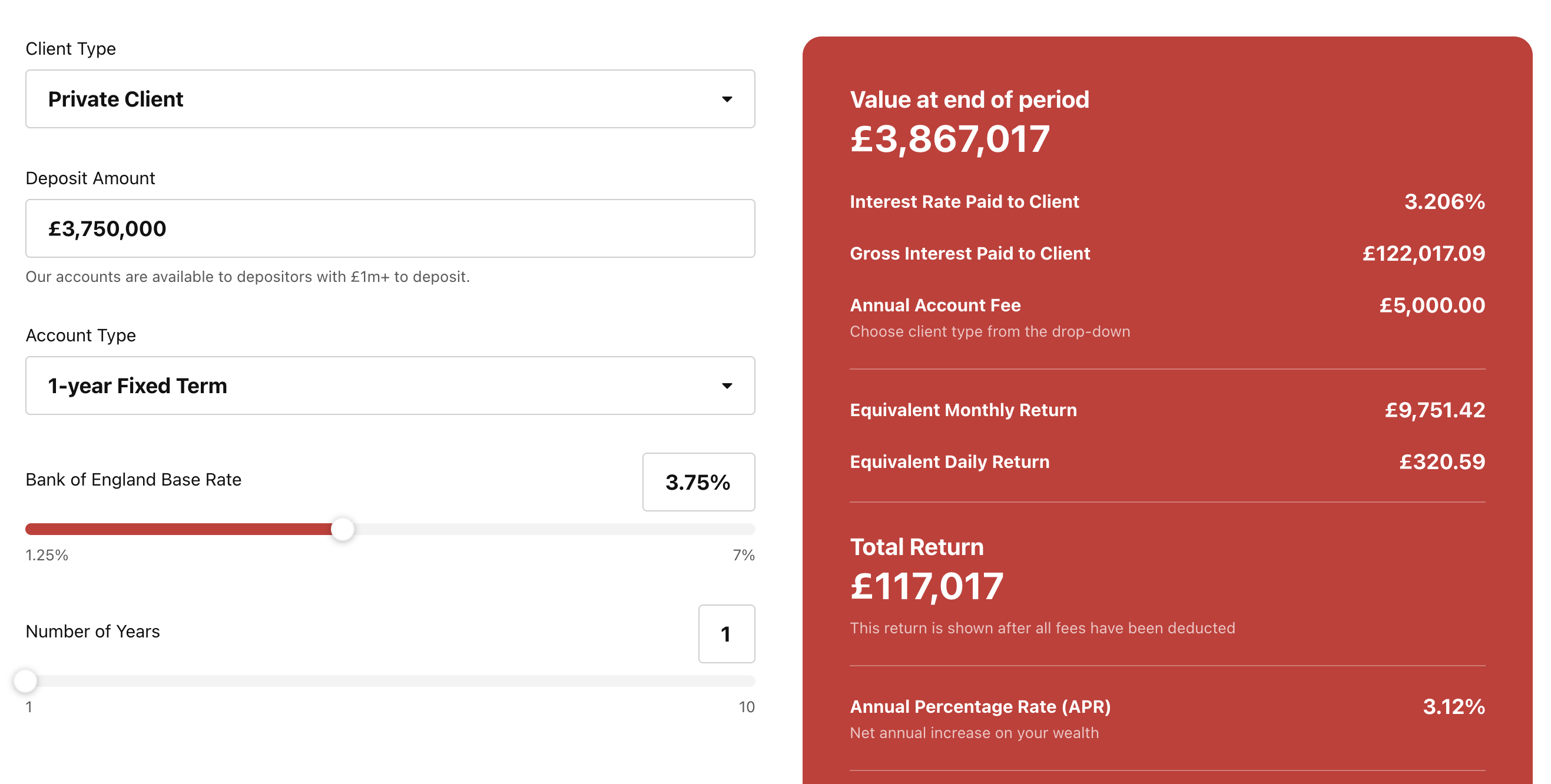
Interactive Returns Calculator

Choose your deposit amount (from £1 million)
Enter the forecast Bank of England Base Rate
See your projected returns live in the calcuator

Still have questions?

Can’t find the answer you’re looking for? Check out our Frequently Asked Questions or contact our friendly team who will be happy to help.
Cash Deposit Manager

Articles

Articles about our high-interest, zero-risk accounts
Cash Deposit Manager

Bank Accounts with B Corporations (UK)

Certified B Corporation banks balance profit with people, planet and purpose.
Cash Deposit Manager

Investing fees in advance to generate a return for independent schools

With independent schools holding more fees in advance than ever before, we look at how advance payment schemes can help generate an ongoing return.
Cash Deposit Manager

Can interior designers earn interest on FF&E procurement funds?

The answer to this question depends on the answer to the slightly trickier question, "does the interior designer purchase as principal or agent"?
Cash Deposit Manager

Which bank account should a lottery winner use for their winnings?

While it may feel low on the list of priorities, choosing wisely can protect new-found wealth and deliver significant returns.